The Silent Gap: Why Workforce Platforms Broadcast but Never Hear
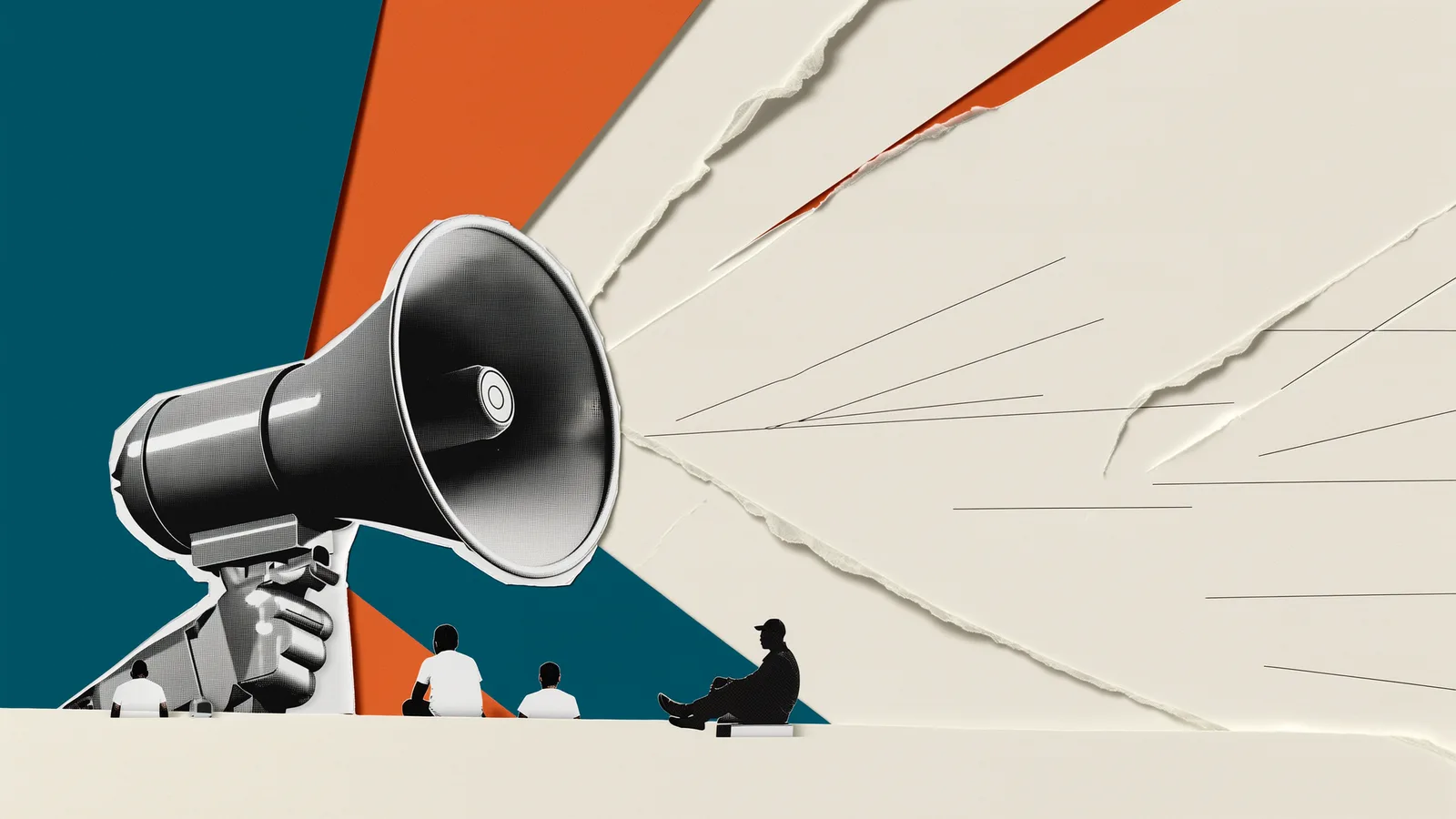
Every major workforce system, from HCM and payroll to scheduling and LMS, is built to push information out and has no mechanism to know whether anyone understood it, agreed with it, or needed help. That gap between what an organisation sends and what its people actually take in is where rework, escalations, compliance failures, and quiet attrition begin. It is not a survey problem. It is a missing layer in the architecture.
A policy update goes out to forty thousand people. Read receipts climb through the afternoon. A dashboard turns green. And not one thing in that entire chain can tell you whether a single employee understood what changed, whether they disagreed, or whether half the frontline is now confused about a process they will run tomorrow. The system did its job. It broadcast. Hearing was never in scope.
Why do workforce platforms broadcast but never hear?
Workforce platforms broadcast but never hear because they were architected as one-way distribution systems. Every core function, whether announcements, pay changes, shift assignments, or policy acknowledgements, moves information from the organisation to the employee. The return path, if it exists at all, is a click, a timestamp, or a status flag.
Think about what these systems are actually measuring. A read receipt records that a screen was opened. An acknowledgement records that a button was pressed. A completed training module records that a video ran to the end. None of these tell you what happened inside the person’s head. They confirm delivery, not comprehension.
This was a reasonable design when the goal was administrative control. You needed proof that the message went out and proof that the box was ticked. But somewhere along the way the tick became a stand-in for understanding, and organisations started making decisions as if a green dashboard meant the workforce was aligned. It doesn’t. It means the software advanced.
And the scale of the resulting blind spot is measurable. Axios HQ’s 2025 research found that 45% of leaders believe they proactively engage employees on difficult topics. Only 23% of employees agree with them. Both groups are describing the same communications, sent through the same channels. The gap is that the channel gives leaders no way to know what actually landed.
What does one-way communication actually cost?
One-way communication is expensive precisely because the cost is invisible at the point it is created. The bill arrives later as rework, escalations, compliance exposure, and people who quietly disengage before they leave. Nothing on the broadcast dashboard predicts any of it.
Here is the causal chain. A change is communicated. Some fraction of the workforce doesn’t understand it, but there is no return path to surface that confusion, so it stays hidden. Those people act on their best guess. The guesses are wrong at some rate, which produces errors. The errors get caught downstream, usually by a manager or a support queue, and now someone senior spends an afternoon diagnosing a problem that a two-minute conversation at the source would have prevented. Axios HQ puts a figure on exactly this: ineffective communication costs organisations roughly $54,860 a year for every senior employee earning over $200,000, because a third of leaders report being pulled off their actual work to fight fires that clearer communication would have prevented.
Break the cost into where it lands:
- Rework. A process gets run the old way after it changed. The output has to be redone, and the person who redid it loses trust in the next announcement.
- Escalations. Confusion that could have been resolved at the point of delivery becomes a ticket, an HR query, a manager’s afternoon. Volume in the support queue is often just broadcast failure arriving late.
- Compliance exposure. An acknowledgement click is treated as proof of understanding in an audit. It isn’t. Brandon Hall Group research found organisations with compliance training completion rates below 70% are 3.5 times more likely to face violations, and the uncomfortable implication runs the other way too: a 95% completion rate proves 95% of people clicked. It proves nothing about comprehension.
- Attrition. People who feel unheard stop contributing before they stop showing up. Gallup’s State of the Global Workplace put engagement at 21% in 2024, an estimated $438 billion in lost productivity, and the 2026 edition shows it slipping again to 20%. Disengagement is what the silent gap looks like on a lag.
None of these show up in the broadcast metric. That is the point. The metric rewards the thing that is easy to measure, delivery, and stays blind to the thing that matters: whether the delivery landed.
Isn’t this what employee surveys are for?
Surveys are the industry’s attempt to bolt a return path onto systems that were never built to have one, and they fail for structural reasons, not effort reasons. They arrive after the moment, they ask everyone the same questions regardless of context, and they cannot tell a considered answer from one given to make the screen go away. A survey is a periodic snapshot. The silent gap is continuous.
Consider the timing problem alone. A quarterly engagement survey asks how someone feels about a change that happened eleven weeks ago, by which point the confusion has already hardened into a workaround and the frustration has already been rationalised or forgotten. You are measuring the residue, not the moment.
Then there is the compression problem. When people are asked to answer at a moment that isn’t theirs, in a format that offers no room to explain, they compress. They pick the middle option. They agree to move on. A respondent on autopilot and a respondent thinking carefully produce identical survey rows, and the platform cannot tell them apart. So the data comes back looking complete and carries almost no signal about the conditions under which it was given.
And surveys assume the willingness to speak that they are supposed to measure. Perceptyx research suggests roughly a third of employees hold back what they really think because they don’t feel safe saying it, and a form does nothing to change that calculus. If anything, an impersonal survey with an unclear audience makes the safest answer the emptiest one.
The deeper issue is that surveys treat hearing as an event, something you schedule and run and file. Hearing is not an event. It is a property the underlying systems should have and don’t.
Where does the gap show up first?
The gap surfaces earliest wherever employees are already communicating around the system instead of through it. The clearest current example is how people are quietly using AI at work. When behaviour moves faster than the organisation’s ability to hear about it, the silent gap stops being theoretical.
More than half of workers in recent Cornerstone research say they rarely or never tell their managers or colleagues they are using AI. The interesting part is that this silence isn’t mostly about shame. Confidence is high. People just have no natural channel to say what they are doing, so they don’t. The organisation is running an uncontrolled experiment on its own workflows and has no instrument that would tell it.
That is the silent gap in miniature. Something material is happening across the workforce. The people involved are not hiding it out of fear. There is simply no path for the information to travel back up, and so it doesn’t. Every workforce system in the building is broadcasting policies about AI while remaining structurally deaf to how AI is actually being used.
Multiply that pattern across onboarding, safety changes, restructures, pay, and process updates, and you have the real shape of the problem. It is not that employees say too little. It is that the software has no way to hear them when they do.
Who falls through the gap entirely?
The employees the broadcast model serves worst are the ones there are most of. Roughly 80% of the global workforce is deskless: around 2.7 billion people on warehouse floors, in clinics, on construction sites, behind wheels, and on shop floors. Every assumption baked into the standard return path, a desk, a laptop, a quiet hour, an inbox checked daily, fails for them.
These are also the employees for whom the stakes of being misunderstood are highest. Safety procedures, shift rules, and compliance obligations concentrate on the frontline. Yet training research shows workers remember less than half of what they were trained on immediately after completing it, and without reinforcement retention approaches zero within 30 days. The system records a completion. The knowledge has already left the building.
So the population with the least access to the feedback channel carries the most operational and regulatory risk. Any serious attempt to close the gap has to work for them first: on a phone, mid-shift, in their language, without a login ceremony. A solution that only works for people with desks solves a fifth of the problem.
What would it take to close it?
Closing the gap means treating employee voice as infrastructure, a return path that runs through the systems people already use, rather than a survey you send twice a year. The requirement is a layer that can hold a real conversation at the point of communication and turn what people say into structured signal the platform can act on.
The difference between the two models is worth stating plainly.
The broadcast model:
- Confirms delivery, not understanding
- Measures completion: a click, a timestamp, a status flag
- Offers a return path of exactly one button
- Runs as a scheduled snapshot, weeks or months after the moment
- Produces data that looks complete but carries almost no signal
The voice model:
- Confirms understanding, in the employee’s own words
- Measures comprehension, not whether the screen advanced
- Makes the return path a conversation
- Runs continuously, at the moment the communication lands
- Produces data that carries signal the platform can act on
The point of a return path is not to collect more. Collecting more is the failure mode that got us here. The point is to know, at the moment a change lands, whether it landed, and to catch the confusion while it is still cheap to fix rather than after it has become a ticket, an error, or a resignation.
None of this is comfortable to build. A real return path means the organisation will hear things it would rather not, and it means acting on what it hears, or the channel dies of neglect like every ignored suggestion box before it. That is a genuine cost. It is smaller than the one being paid now in silence.
The platforms that define the next era of workforce software will not be the ones that broadcast more efficiently. They will be the ones that can hear. Everything else is a screen advancing while the room stays quiet.
Frequently asked questions
Is the silent gap just poor internal communication?
No. Poor internal communication is about the quality of what goes out. The silent gap is about the absence of anything coming back. An organisation can have excellent, well-crafted communications and still have no mechanism to know whether any of them were understood. The gap is structural, not a matter of writing better announcements.
Why aren’t read receipts and acknowledgements enough?
A read receipt confirms a screen was opened and an acknowledgement confirms a button was pressed. Neither confirms comprehension, agreement, or that the person had any capacity to raise a concern. Treating a click as proof of understanding is exactly the assumption that hides risk, particularly in compliance contexts where a tick is later presented as evidence.
How is a voice layer different from a better survey?
A survey is periodic, uniform, and arrives after the moment has passed, so it measures residue rather than reality. A voice layer sits at the point of communication, adapts to the individual, and captures response while the moment is live. The distinction is timing and context, a conversation when it matters versus a form weeks later.
Does this only matter for frontline or deskless workers?
It matters most acutely there, because deskless workers are roughly 80% of the global workforce and have the least access to the systems where feedback is collected. But the gap exists across the whole workforce. The quiet, unreported adoption of AI among confident, capable office employees shows the problem is not limited to any one group.
Sources
| Source | What it supports | Link |
|---|---|---|
| Axios HQ, 2025 State of Internal Communications | 45% vs 23% leader and employee perception gap; $54,860 annual cost per senior employee | axioshq.com |
| Gallup, State of the Global Workplace | Engagement at 21% in 2024 ($438bn lost productivity), 20% in 2025 | gallup.com |
| Brandon Hall Group (via Monetizely) | Sub-70% compliance completion means 3.5x higher violation risk | getmonetizely.com |
| Cornerstone OnDemand, The Silent Rise of AI at Work | Most workers rarely tell managers they use AI | cornerstoneondemand.com |
| Perceptyx | ~30% of employees withhold what they really think | perceptyx.com |
| TalentCards, State of Deskless Workforce Training | Deskless workers as ~80% of the global workforce; post-training retention | talentcards.com |
Give every employee a voice
Tadeus holds real voice conversations with your whole workforce at once and returns structured records to the systems you already use.
Start for free